
Exercise · 8 each side
Dead Bug: how to do it (with pictures)
Lower opposite arm and leg.
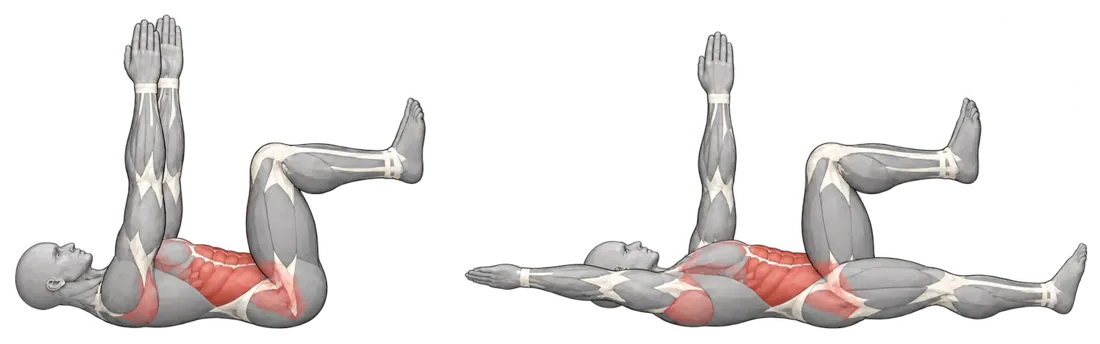
WorksDeep abdominals
The dead bug is a slow core exercise done on your back: you lower one arm and the opposite leg while your trunk stays still. It does not train the pelvic floor directly, but it teaches your deep abdominals to work with your breath, which supports the pelvis from above.
How to do it
- Arms up, knees over hips
- Lower opposite arm and leg
- Lower back stays on the floor
How to know it is working
You should feel a steady, low effort deep in your belly. You should not feel your lower back arch, your neck strain or your breath stop. Slide a hand under your lower back: if the gap grows as the leg lowers, the range is too big. Keep the pelvic floor relaxed, not clenched.
Common mistakes
- Holding your breath during each reach. Breathe out as the arm and leg lower and breathe in as they return.
- Moving fast and swinging the limbs. Take about three seconds to lower and three to return, so the abs do the work instead of momentum.
- Pushing the belly out or bearing down. Draw the lower belly gently in and up, never down into the pelvis. If you feel pressure low down, reduce the range.
Make it easier or harder
Easier: Keep your arms on the floor and lower one leg at a time, tapping the heel down with the knee bent.
Harder: Straighten the leg fully as it lowers, or add a gentle Kegel on each exhale and fully relax on the inhale.
Who it helps
Useful for desk workers, lifters who want a stable trunk, and anyone returning to exercise who needs a low-load start.
Skip it or get checked first if
Check with a doctor or pelvic floor physiotherapist first after recent abdominal or pelvic surgery, if you notice doming along the middle of your belly, or if you are pregnant or recently gave birth. If back pain sharpens, reduce the range. Stop if it hurts.
Questions
Is the dead bug good for the pelvic floor?
Indirectly. It trains the deep abdominals and breathing that work alongside the pelvic floor, so pair it with separate Kegels.
Why does my lower back lift off the floor?
Your abs cannot yet control that range. Lower the leg less far, bend the knee more and move slower until the back stays down.
In these workouts
For men
- Pelvic Floor Exercises for Men: 6-Move Beginner Routine
- Pelvic Floor Exercises for Men Over 40
- Pelvic Floor Workout for Lifters: Before Heavy Squats
- Core and Pelvic Floor Workout for Men: No Equipment
For women
Time your Kegels with Kegel Morse Hero
The app guides each squeeze and release with a ring and haptics, so you can train the Kegel part of this routine eyes-free. No account, no ads.
Download on theApp StoreGet it onGoogle PlayNot medical advice. Stop if anything hurts. If you have pain, leaking or other symptoms, or have had pelvic surgery, see a doctor or a pelvic floor physiotherapist first. Medical disclaimer.